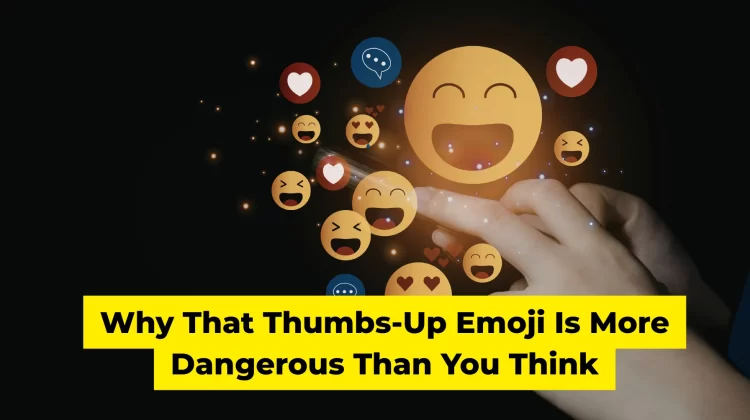
Why That Thumbs-Up Emoji Is More Dangerous Than You Think
A Guide to Modern Hand Signals: The $50,000 Finger
In 2022, NBA star Kyrie Irving was fined $50,000 for a single raised middle digit directed at a Boston crowd. Decades earlier, former President George W. Bush committed one of the most famous diplomatic faux pas in history when he gave a “V-sign” to an Australian crowd with his palm facing inward—unwittingly telling the entire nation to “go screw themselves.”
These incidents are high-stakes failures in the deployment of “emblems”—gestures with conventionalized forms and stable meanings within specific communities. In the lexicon of a digital sociologist, these are “extra-grammatical vocalizations” of the body; stable semiotic units that function with the same weight as spoken words. In our hyper-connected era, the assumption that these signs are universal is a profound liability. As we send over 10 billion emojis daily, we are finding that our most common visual symbols are often the most misunderstood.
The Thumbs-Up Paradox: Affirmation or “Up Yours”?
In Western digital culture, the thumbs-up is “efficiency emojified”—a quick “got it” or “sounds good.” However, this same sign acts as a “foul gesticular insult” in many Islamic, Asian, and Middle Eastern countries. In Iran, the gesture is traditionally the equivalent of the Western middle finger, conveying a crude “up yours,” though younger generations are beginning to adopt the Western meaning through digital exposure. In Nigeria, the translation is even more biting: “sit on it.”
The complexity of emblems is best seen in the Indian context. The gesture is generally well-accepted—evidenced by the massive popularity of the “Thums Up” soda brand. However, the meaning is entirely dependent on movement dynamics. If the hand is wagged from side to side in a “reverse-pendulum” motion, the affirmation vanishes, replaced by a firm signal of disagreement or a warning that something “won’t work.”
As noted in cross-cultural research:
“Thumbs up” traditionally translates as the foulest of gesticular insults in some Middle Eastern countries—the most straightforward interpretation is “Up yours, pal!”
Originally popularized by World War II pilots as a signal for takeoff, the gesture’s transition from a cockpit tool to a global insult underscores the volatile nature of visual semiotics.
The Roman Reversal: Everything You Know About Gladiators Is Wrong
Our modern binary of the thumbs-up (life) and thumbs-down (death) is a historical inversion. In Ancient Rome, the phrase pollice verso (“with turned thumb”) was the signal for judgment. Historical evidence suggests that a “thumbs down” likely signaled the victor to put his sword in the ground, sparing the gladiator. Conversely, a “thumbs up” was a gesture of death, mimicking the upward thrust of a blade through the throat.
This misunderstanding was not accidental; it was “rebranded” for the modern imagination by Jean-Léon Gérôme’s 1872 painting Pollice Verso. By depicting the crowd using a thumbs-down to demand blood, Gérôme rewrote two millennia of history in a single frame. This illustrates the terrifying power of visual media: society often prefers a “simplified” version of history over the grim accuracy of the past, proving that even our historical “truths” are often just successful marketing.
The $2 Billion Industry Translating Your “Smiley”
The “Emoji Localization” market is currently valued at $2 billion and is expanding at a rate of 12.8% year-over-year. This is not merely a niche service; it is “linguistic insurance” for a world where 68% of global businesses report miscommunication incidents. In an era of “on-record” digital communication, a misplaced icon is a risk-mitigation nightmare.
Professional localization involves a rigorous audit of digital semiotics:
- Cultural Appropriateness Auditing: Identifying symbols that trigger “arrest or violence” warnings, such as the “Dog Call” in the Philippines—a curling finger reserved for animals that can lead to physical altercations.
- Platform-Specific Rendering Analysis: Accounting for how an emoji looks on an iPhone versus a Samsung, which can shift sentiment by up to 2.5 points on a 5-point scale.
- Tone and Sentiment Verification: Ensuring “paralanguage” doesn’t backfire. For example, the waving hand (👋) is a friendly “hello” in the West, but on Chinese platforms like WeChat, it is an offensive sign-off meaning “we are no longer friends.”
- Context-Based Mapping: Recognizing that 41% of Brazilian respondents associate the “OK” sign (👌) with offensive or vulgar meanings, necessitating a substitute for Latin American markets.
Generational Warfare: When Emojis Become Passive-Aggressive
A “localization” crisis is also brewing within Western borders, divided by age rather than geography. Millennials view the thumbs-up emoji as no-nonsense neutrality. Gen Z, however, finds it “unsettling,” “hostile,” and “super rude.”
To a digital native, the “no-nonsense neutrality” of a simple thumb is a hidden dig—a refusal to engage in the warmth of a heart or a typed response. Because digital visual acts are part of an “unspoken record,” Gen Z perceives the brevity of the thumb as an intentional coldness. This reflects the blurring lines between formal and informal communication, where “efficiency” is often misread as “passive-aggression.”
The “OK” Sign’s Dark Transformation
The “OK” gesture (👌) is perhaps the ultimate localization nightmare. Beyond the 41% offensive association in Brazil, Turkey, and Russia—where it represents a vulgar anatomical reference—the sign has undergone a “symbolic appropriation” by extremist groups.
In 2019, it was officially entered into hate symbol databases. This transformation shows that emblems are never static; they are susceptible to being hijacked and recontextualized. For brands and individuals, this forces a constant re-evaluation of even the most benign icons. A symbol that meant “all good” yesterday may be a fireable offense today.
In the modern era, the “on-recordness” of our paralanguage has made hand gestures and emojis “finable” and “fireable” offenses. We have entered a period where “Digital Code-Switching”—the ability to adjust your visual vocabulary based on cultural and generational context—is no longer a luxury; it is a 21st-century survival skill.
As we navigate a landscape where a simple wave can mean “hello” or “never come back,” we must confront the fragility of our connections. In a world of silent signals, are we truly communicating, or are we all just hoping nothing gets lost in translation?