The Compliance Gap: Why AI Alone Isn’t Enough
Artificial intelligence is transforming the way we communicate. With tools like automatic translation apps, voice recognition software, and AI-driven chat systems, it seems easier than ever to connect across languages. For many, these innovations promise a world where language barriers disappear entirely. But for organizations that operate in healthcare, education, or government, the story is more complex. When it comes to language access and compliance, relying on AI alone is not enough.
This article explores the gap between what technology can do and what compliance requires. It will show why human interpreters remain essential for meeting legal obligations, ensuring confidentiality, and maintaining trust with multilingual communities. It will also highlight how VM Language Access helps organizations bridge this gap responsibly and effectively.
Understanding Language Access Compliance
To understand why AI tools fall short, we first need to understand what compliance really means in the context of language access. In the United States, language access requirements are not optional. They are rooted in federal law.
What Is Language Access Compliance?
Language access compliance refers to an organization’s responsibility to provide meaningful access to services for individuals with limited English proficiency, often called LEP individuals. This responsibility stems from Title VI of the Civil Rights Act of 1964, which prohibits discrimination based on national origin. Federal agencies and any organizations receiving federal funding must take reasonable steps to ensure that LEP individuals can understand and access services in their preferred language.
Other laws reinforce this requirement. Section 1557 of the Affordable Care Act extends language access obligations in healthcare. The Americans with Disabilities Act (ADA) addresses accessibility more broadly, including for those with communication barriers. Executive Order 13166 requires federal agencies and recipients of federal funds to improve access for LEP individuals.
Compliance, therefore, is not simply about good customer service. It is a legal obligation. Failing to provide adequate interpretation or translation services can result in penalties, lawsuits, and loss of funding.
Industries Most Affected by Language Access Laws
While all public-facing institutions benefit from language access, some sectors have particularly high compliance standards.
Healthcare: Hospitals, clinics, and insurance providers are required to offer qualified interpreters to patients who do not speak English fluently. Miscommunication about treatment, medication, or consent can have life-threatening consequences.
Education: Schools must ensure that parents and students who speak other languages understand their rights, programs, and services. For example, during Individualized Education Program (IEP) meetings, interpreters help parents actively participate in decisions about their children’s education.
Government and Public Services: State and local agencies, from law enforcement to social services, must provide access to information in multiple languages. Failure to do so can limit civic participation and violate civil rights.
Each of these fields involves sensitive, high-stakes communication. A small mistranslation can lead to a serious misunderstanding, making compliance not only a legal necessity but a moral one.
Why AI Alone Cannot Ensure Compliance
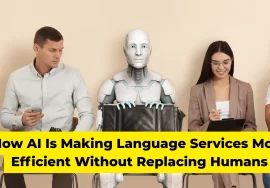
Artificial intelligence is a powerful tool, but when it comes to compliance, it is not a substitute for human expertise. Many organizations are tempted by AI’s affordability and convenience, yet these tools have clear limitations.
AI Translation Tools Lack Accountability
AI translation systems work by analyzing data and predicting the most likely translation based on previous examples. They do not understand meaning, context, or nuance in the human sense. More importantly, they are not accountable. If an AI mistranslates a sentence in a patient’s chart or a legal notice, there is no certified interpreter to verify accuracy or take responsibility for the error.
In compliance settings, accountability is essential. A translation must be auditable, meaning there should be documentation of who performed it and what qualifications they held. With AI, there is no audit trail, which makes it impossible to verify compliance.
There are also privacy concerns. Even when companies claim to use “on-device” processing, sensitive data can still be exposed through cloud backups, device synchronization, or third-party integration. When dealing with patient records, legal documents, or employee information, this risk is too great to ignore.
Accuracy and Cultural Nuance Are Non-Negotiable
AI systems struggle with context. They translate words, not intent. For example, a literal translation of a phrase that includes cultural or idiomatic meaning may confuse or even offend the listener. In healthcare or law, such misunderstandings can have severe consequences.
A bilingual phrase might mean something harmless in one country but carry a negative or taboo connotation in another. Only human interpreters can identify these subtleties and adjust the message appropriately. Cultural misinterpretation in translation can lead to serious misunderstandings, which is why professional interpreters are trained to handle nuance with care.
AI Does Not Meet Federal “Qualified Interpreter” Standards
The law defines a “qualified interpreter” as someone who can interpret effectively, accurately, and impartially, using any specialized terminology required by the situation. AI tools do not meet this definition. They cannot assess tone, detect ambiguity, or handle clarification requests in real time.
Title VI and the Affordable Care Act require organizations to provide qualified human interpreters for LEP individuals. Relying solely on AI could therefore place an organization out of compliance, even if it appears to save time or money.
The Risk of Discrimination Claims
Using AI-only language tools can unintentionally lead to discrimination. If LEP individuals cannot fully understand or participate in interactions due to poor translation, they are effectively denied equal access. This may result in civil rights complaints or legal action.
The Department of Justice has previously investigated hospitals, schools, and government offices for such violations. The message is clear: providing inadequate or unqualified language assistance is not just a technical issue, it is a compliance failure.
How Organizations Can Close the Compliance Gap
Organizations can take concrete steps to ensure they remain compliant and inclusive.
Step 1: Conduct a Language Access Audit
Start by reviewing your current language services. Identify which areas rely too heavily on technology and where professional interpreters are needed. A comprehensive audit will reveal potential risks before they become compliance issues.
Step 2: Partner With a Qualified Language Provider
Not all language service providers are the same. Look for a partner with experience in regulated industries, strong confidentiality policies, and a proven record of compliance support. VM Language Access offers all of these qualities, along with flexible pricing and multilingual expertise.
Step 3: Train Staff and Build Awareness
Compliance is a team effort. Staff should understand when and how to request interpretation services, the importance of confidentiality, and the limitations of AI tools. VMLA can help organizations develop training programs to promote these best practices.
Technology has its place in modern communication, but it cannot replace the human touch. AI tools are impressive, but they do not understand culture, emotion, or context. When compliance, ethics, and clarity matter, human interpreters are indispensable.
Language access compliance is not just about avoiding penalties. It is about ensuring fairness, inclusion, and respect for every individual who interacts with your organization. By partnering with VM Language Access, institutions can bridge the compliance gap, protect sensitive information, and communicate with confidence in every language.
VMLA combines the efficiency of technology with the irreplaceable accuracy and empathy of human interpreters. That is how real communication happens, and how compliance becomes a cornerstone of trust, not just a box to check.