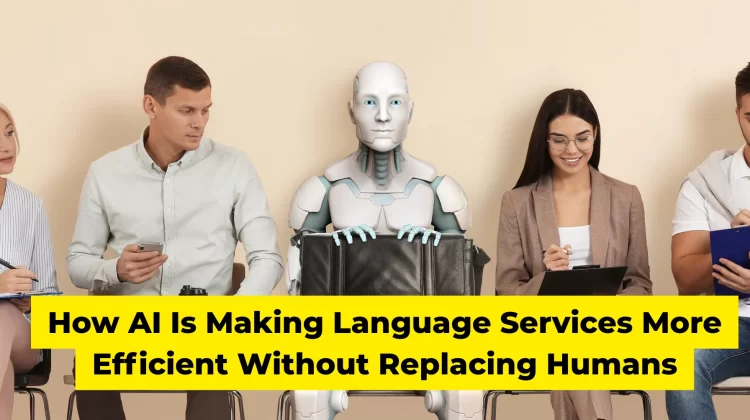
How AI Is Making Language Services More Efficient Without Replacing Humans
Artificial intelligence has become part of everyday life faster than many people expected. From writing assistance to image generation and real time speech recognition, AI tools are now deeply integrated into how businesses operate. The language services industry is no exception. Translation, interpretation, transcription, and localization workflows increasingly rely on AI powered tools to improve speed and consistency.
At the same time, there is a growing concern that AI might replace human linguists altogether. This fear often shows up in headlines and social media debates. The reality, however, is far more balanced and far more optimistic. AI is not replacing human translators and interpreters. Instead, it is reshaping how they work and helping the industry deliver better results at scale.
This article takes a fact based and educational look at how AI is improving efficiency in language services while reinforcing the essential role of human expertise. We will explore real world use cases, industry research, and practical examples that show why collaboration between humans and technology is shaping the future of language access.
The Evolution of Language Services in a Digital World
From Traditional Translation to Technology Supported Workflows
Language services have always evolved alongside technology. Decades ago, translation was done entirely on paper, with physical dictionaries and handwritten notes. As computers became more accessible, linguists shifted to digital documents and word processing software. The introduction of computer assisted translation tools marked a major turning point.
These tools did not translate content on their own. Instead, they supported human translators by storing previous translations, managing terminology, and improving consistency. This shift allowed professionals to work more efficiently without sacrificing quality. AI based tools are simply the next step in this evolution.
Why Efficiency Has Become a Priority Across Industries
Global communication has increased dramatically. Businesses operate across borders, governments serve multilingual populations, and healthcare systems care for patients who speak dozens of languages. The volume of content that needs translation has grown faster than the number of available linguists.
Efficiency is no longer optional. Organizations need faster turnaround times, consistent terminology, and scalable solutions. AI helps meet these demands by automating repetitive tasks while leaving complex decision making to humans.
Understanding AI in Language Services
What AI Can Do Well in Translation and Interpreting
AI excels at processing large amounts of data quickly. In language services, this means identifying patterns, suggesting translations based on prior examples, and recognizing speech with impressive accuracy under controlled conditions.
Machine translation engines can generate draft translations in seconds. Speech recognition tools can transcribe audio in real time. These capabilities save time, especially during early stages of a project or when handling large volumes of content.
Common AI Tools Used in Language Services Today
Several AI driven tools are widely used across the industry. Machine translation engines generate initial drafts. Translation memory systems store previously approved translations. Terminology management tools help maintain consistent vocabulary. Speech to text tools support transcription and interpreting workflows.
Importantly, these tools are designed to assist humans rather than replace them. They work best when guided, reviewed, and corrected by trained professionals.
The Difference Between Automation and Intelligence
One common misunderstanding is assuming that AI understands language the same way humans do. AI does not comprehend meaning, emotion, or cultural nuance. It predicts patterns based on data. This distinction explains why human oversight remains essential, especially in sensitive or high risk settings.
How AI Improves Efficiency Without Eliminating Human Expertise
Faster Turnaround Times Through Machine Assisted Translation
Machine assisted translation allows linguists to start with a draft rather than a blank page. This speeds up the process significantly, especially for repetitive or technical content. Human translators then refine the output, correct errors, and adjust tone.
Studies consistently show that this approach increases productivity without reducing quality when managed properly.
Improved Consistency with Translation Memory and Glossaries
Consistency is critical in legal, medical, and technical fields. AI powered translation memory tools ensure that approved terms and phrases are reused accurately. This reduces confusion and improves clarity for end users.
Human linguists remain responsible for approving terminology and deciding when deviations are necessary based on context.
Cost Optimization Without Sacrificing Quality
By automating repetitive tasks, AI reduces the time required for certain projects. This can help organizations manage costs more effectively while still relying on human expertise for review and quality control. The result is a more sustainable model for long term language access.
The Limits of AI in Language Services
Cultural Context and Meaning Beyond Words
Language is deeply tied to culture. Humor, idioms, politeness levels, and social norms vary widely across regions. AI struggles with these elements because they require lived experience and cultural awareness.
A phrase that is acceptable in one culture may be offensive or confusing in another. Human linguists understand these subtleties and adjust language accordingly.
Tone, Emotion, and Intent in Human Communication
Interpreting and translation often involve emotionally charged situations such as medical consultations, legal proceedings, or community meetings. AI cannot read body language, adjust tone in real time, or respond empathetically.
Human interpreters do far more than convert words. They facilitate understanding between people.
High Risk Scenarios Where AI Alone Falls Short
In healthcare, legal, and government contexts, errors can have serious consequences. Regulations and ethical standards often require qualified human interpreters. AI tools do not meet these requirements on their own.
Why Human Linguists Remain Essential
Cultural Competence and Regional Knowledge
Human linguists bring regional knowledge that no algorithm can replicate. Spanish spoken in Mexico differs from Spanish spoken in Argentina or Spain. These differences matter in real world communication.
Ethical Judgment and Accountability
Professional linguists follow ethical guidelines related to confidentiality, accuracy, and impartiality. They are accountable for their work. AI systems do not carry responsibility or ethical judgment.
Complex Decision Making in Real Time Communication
Simultaneous interpreting requires rapid decision making, anticipation, and adaptability. These skills are uniquely human and developed through training and experience.
The Human AI Collaboration Model
How Linguists Use AI as a Support Tool
Many professionals view AI as a productivity assistant. It handles repetitive tasks so linguists can focus on meaning, tone, and accuracy. This collaboration improves job satisfaction and reduces burnout.
Quality Control Through Human Review
Human review remains the cornerstone of quality assurance. Linguists evaluate AI output, correct mistakes, and ensure the final product meets professional standards.
Productivity Gains Without Job Displacement
Industry data shows that demand for language services continues to grow. AI has not reduced the need for human linguists. Instead, it has changed how they work and expanded opportunities for specialization.
Industry Examples of Human and AI Collaboration
Healthcare and Patient Communication
AI assists with transcription and document translation, while human interpreters handle patient interactions and complex explanations. This combination improves access without compromising safety.
Legal and Regulatory Environments
Legal translation relies on terminology management tools supported by human expertise. Accuracy and accountability remain non negotiable.
Education, Government, and Public Services
Public institutions use AI to manage volume while relying on human linguists to ensure compliance, accessibility, and cultural appropriateness.
Research and Industry Trends Shaping the Future
Studies on AI Assisted Translation Accuracy
Research shows that AI assisted workflows can improve efficiency when paired with human review. Fully automated translation without oversight consistently underperforms in complex contexts.
Workforce Trends in the Language Services Industry
Rather than shrinking, the industry is diversifying. New roles focus on quality management, localization strategy, and technology integration.
Why Demand for Skilled Linguists Is Growing
Globalization, migration, and digital communication continue to increase demand for language access. Human skills remain at the center of this growth.
Addressing Concerns About AI Replacing Human Linguists
Myths vs Reality in Language Automation
AI does not replace understanding. It processes data. Human expertise remains essential for meaningful communication.
Why Language Is More Than Data
Language carries identity, emotion, and culture. These elements cannot be reduced to algorithms.
The Long Term Role of Human Expertise
The future of language services is collaborative. Technology enhances human capability rather than replacing it.
Best Practices for Organizations Adopting AI in Language Services
- Organizations benefit most when they invest in both technology and people. One without the other creates risk.
- Ongoing training helps professionals use tools effectively and maintain high standards.
- Clear guidelines, human oversight, and accountability remain critical.
The Future of Language Services in a Human Centered AI Era
- AI enables innovation, but people create connection. The industry continues to prioritize human understanding.
- When technology and human expertise work together, communication becomes more inclusive and effective.
Final Thoughts on Responsible Language Technology Adoption
AI is transforming language services in powerful ways. It improves efficiency, consistency, and scalability. At the same time, it highlights the irreplaceable value of human linguists. The most successful approaches recognize that technology is a tool, not a substitute for human understanding.
Some language service providers, such as VM Language Access, align with these best practices by integrating technology thoughtfully while maintaining a strong focus on professional standards, cultural awareness, and human expertise. This balanced approach reflects where the industry is headed and why collaboration, not replacement, defines the future of language services.