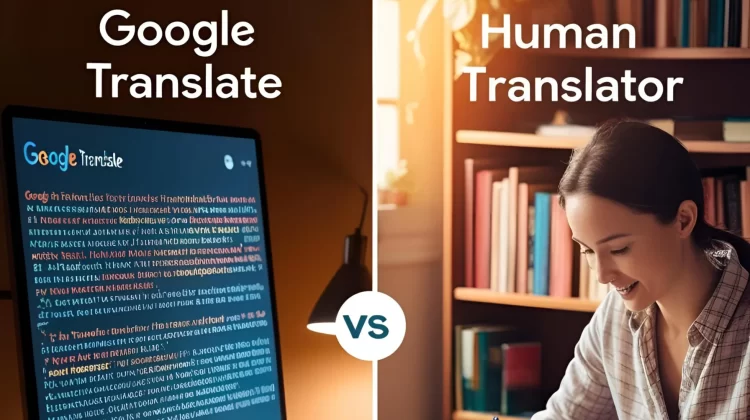
Google Translate vs. Human Translators: Accuracy, Nuances, and Pitfalls
In today’s fast-paced, globalized world, the need for quick translations is ever-present. As a result, tools like Google Translate have surged in popularity, offering instant and convenient translation services at the click of a button. But, as useful as these tools are, there’s an ongoing debate: Can Google Translate really replace human translators? Does it provide the accuracy required for complex translations, or does it fail to capture the subtleties of language that only a human can understand?
In this article, we’ll take a deep dive into the capabilities of Google Translate, explore its accuracy issues, and discuss why human translators are still essential in many situations. From the rise of machine translation to the enduring importance of human skill in translation, we’ll break down how these two approaches compare.
The Rise of Machine Translation: Google Translate’s Impact
Google Translate has revolutionized the way people communicate across language barriers. Launched in 2006, it now supports over 100 languages and handles millions of translations every day. For many people, especially those with casual translation needs or when traveling, Google Translate offers an incredibly convenient solution.
What’s more, Google Translate’s use of artificial intelligence (AI) and machine learning has made it more efficient over time. It learns from vast amounts of data and continually refines its translations to improve accuracy. This technology, known as neural machine translation (NMT), is at the heart of Google’s translation engine, allowing it to produce translations that are more fluent and natural than earlier models.
However, while these advancements have led to significant improvements, they haven’t solved all the challenges faced by machine translation. Google Translate’s technology is far from perfect and often still struggles with certain aspects of language.
Google Translate Accuracy Issues: Why Machine Translation Falls Short
One of the primary concerns with Google Translate is its accuracy. While it does a decent job for many straightforward translations, it falters when it comes to more nuanced language. Here are a few reasons why Google Translate might not be as accurate as human translators:
Context Matters, and Google Translate Misses It
One of the biggest limitations of Google Translate is its inability to understand context. Language is incredibly complex, and meaning can change depending on the situation, tone, and cultural background. For example, the word “bank” could refer to a financial institution, the side of a river, or even a place where you store resources in a video game. Without understanding the context of a sentence, Google Translate can’t always determine which definition of “bank” is correct.
A simple sentence like “I’m going to the bank” could be translated as “Voy a la banco” (incorrect usage of “banco”), when the correct translation depends on whether the context is financial or geographical. Machine translation vs. human translation becomes stark here—humans naturally understand context, while machines lack that level of comprehension.
Complex Sentences Are a Challenge
Another common Google Translate accuracy issue arises when translating complex or compound sentences. These often involve multiple clauses, advanced sentence structures, and more intricate language rules that require a nuanced understanding. Google Translate often struggles to handle these properly, leading to awkward, incorrect, or hard-to-understand translations.
Take the sentence “The quick brown fox jumps over the lazy dog” as an example. While Google Translate can easily translate this simple sentence into other languages, more complex sentences with multiple clauses or indirect references can result in a translation that sounds robotic or unnatural.
Google Translate Fails with Idiomatic Expressions
Idiom translation is another area where machine translation struggles. Idiomatic expressions—phrases whose meanings don’t align with their literal translations—pose a huge challenge for Google Translate. For example, if you were to input the English phrase “It’s raining cats and dogs” into Google Translate, the translation might be a literal interpretation that sounds odd in the target language.
A human translator, however, would understand the meaning behind the idiom and would likely replace it with a corresponding phrase in the target language that conveys the same meaning. For instance, in Spanish, a translator might use “Está lloviendo a cántaros,” which means “It’s raining pitchers,” but conveys the same idea.
Cultural Context: Machine Translation Can’t Keep Up
Google Translate doesn’t always account for the cultural context of a language, which can lead to significant misunderstandings. For instance, humor, tone, and cultural references may get lost or misinterpreted by machine translation.
Human translators are not just language experts; they are also culture experts. They understand the subtleties of different cultures, which is crucial when translating content like marketing materials, advertisements, or media. What works in one culture may not work in another. For example, an idiom or joke that works in one country might be offensive or nonsensical in another. A human translator can adjust these nuances to suit the target culture, something Google Translate isn’t yet capable of.
The Role of Human Translators: Where Machines Can’t Replace People
Despite the impressive advancements in machine translation, human translators remain indispensable for several reasons. Here’s why:
Cultural Sensitivity and Nuance
As discussed, human translators bring an invaluable level of cultural sensitivity to translations. They don’t just translate words—they translate meaning, tone, and intent. This is particularly crucial in fields like legal translation, marketing, or literature, where misinterpretation could lead to serious consequences or missed opportunities.
For example, in legal contracts, every word matters. A machine might miss subtle distinctions that a human translator would catch. In marketing, a phrase that’s effective in one language might need to be entirely reworked in another to resonate with the target audience. Human translators can adapt these nuances, ensuring that the translation is both accurate and effective in the target culture.
Handling Specialized Subjects
Human translators are often experts in specific fields, such as medical, legal, technical, or scientific translation. These fields often involve specialized knowledge, and human expertise is essential for understanding complex terminology and concepts. For example, translating medical information requires an in-depth understanding of medical terminology, as well as the ability to adapt translations for different health systems.
Google Translate, on the other hand, may provide a translation that’s technically correct but misses the mark in terms of medical accuracy or terminology. A human translator will ensure that the translation is not only linguistically correct but also appropriate for the specific context.
Creativity and Emotional Expression
In some cases, translations require a creative touch, such as in literature, advertising, and the entertainment industry. Machine translation is limited in this regard. While Google Translate can handle the basic linguistic structure, it struggles to capture the emotion, tone, or artistic expression found in creative works. Human translators are skilled at transferring the feeling and intent of the original text while maintaining the original voice.
For example, translating a poem or a song lyric requires more than just direct translation. It involves finding words that evoke the same emotions and resonance in the target language. This is something only a human translator can do effectively.
When to Use Google Translate and When to Rely on Human Translators
So, when should you use Google Translate, and when should you seek out a professional human translator? Here’s a quick guide:
- Use Google Translate for:
- Personal, informal communication
- Quick translations for everyday use (like signs, menus, and directions)
- Basic vocabulary and simple sentences in languages you’re familiar with
- Use a human translator for:
- Business or legal documents where accuracy and cultural nuances are essential
- Marketing materials that need to resonate with a specific target audience
- Creative content like literature, poetry, or advertising
- Any content where the stakes are high, such as medical translations or sensitive communications
Can AI and Human Translators Coexist?
Looking to the future, it’s likely that machine translation and human translation will coexist, complementing each other. AI tools like Google Translate can serve as valuable assistants, handling routine, everyday translation needs. But for more complex, nuanced tasks, human translators will remain the go-to experts. By leveraging both, we can ensure that translations are accurate, culturally relevant, and contextually appropriate.
In conclusion, while Google Translate has come a long way, it still faces significant accuracy issues that make it unsuitable for many translation tasks. Machine translation vs. human translation reveals the limitations of AI in capturing the full depth of language, including its cultural context, emotional nuance, and specialized vocabulary. Human translators remain essential for achieving the highest level of accuracy and quality, especially in fields where precision matters. By understanding when to use both, we can take advantage of the strengths of each and ensure clear, accurate communication across languages.